AI How-To Guides
A Two-Model AI Workflow for Safer API Rollouts
September 27, 2026 · 7 min
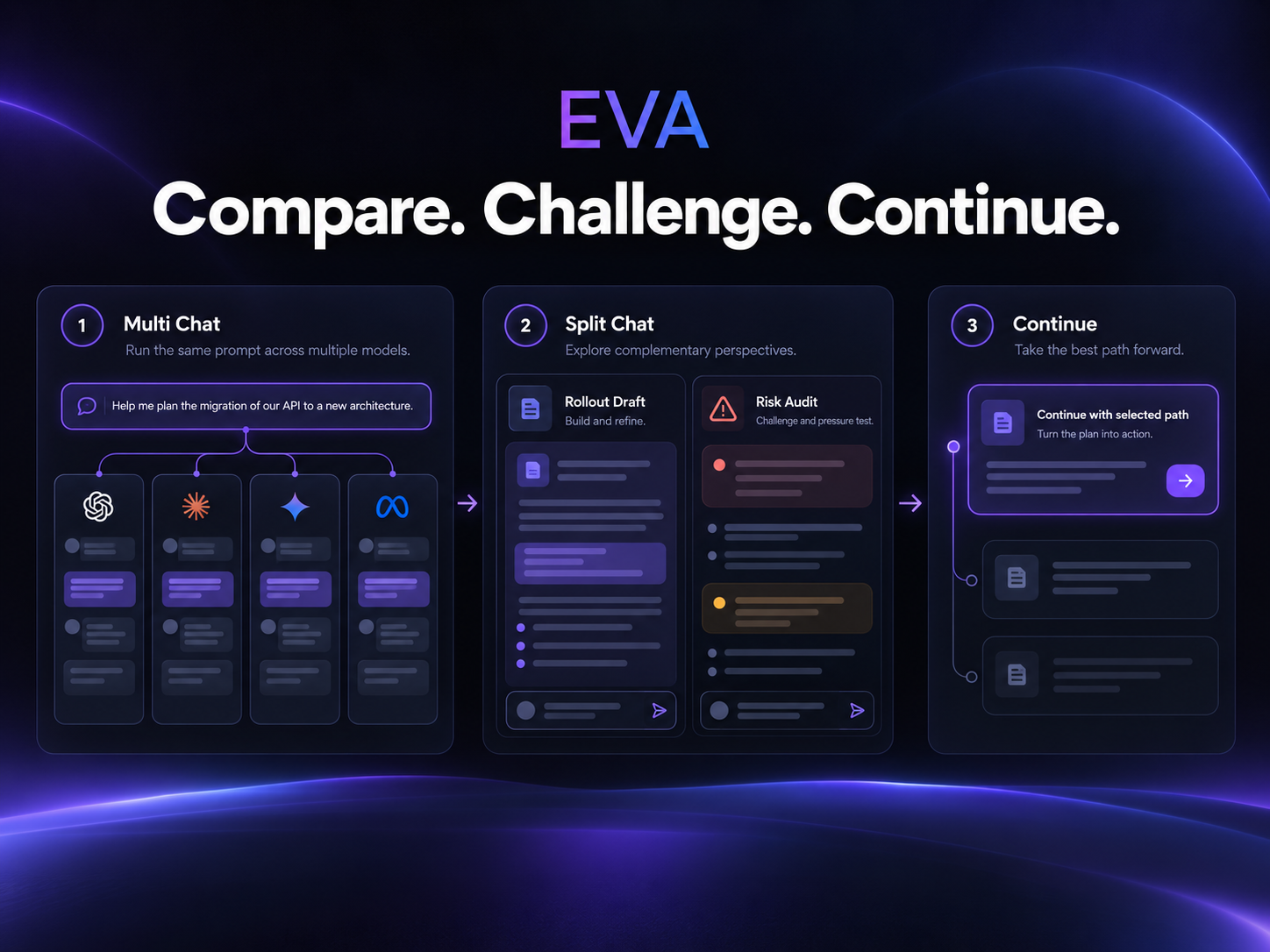
Send the same constrained prompt to each candidate model and choose the plan with the fewest dangerous repairs. Give a second model one narrow job: attack that plan's assumptions and rollback logic. A human should resolve every serious criticism before continuing, because an extra model cannot verify the underlying facts.
The plan looked finished. Rollback was one sentence.
A two-model AI workflow earns its keep when the cost of a plausible mistake is high. Picture a pull request for a public REST API migration: the document covers client communication, dashboards, and launch day, but "roll back if needed" is the entire recovery plan. It reads well. It isn't ready.
Sending that draft to another model with "thoughts?" usually produces an expanded version of the same plan. Give the second session a defined role instead: inspect rollback as the engineer who would have to execute it at 2 a.m.
This guide stays with that v1-to-v2 migration all the way through, including the missing traffic data that both models must leave marked as unknown.
How the two-model AI workflow works
The workflow has three stages: compare, challenge, continue. Those verbs sound simple, but each stage needs a clear stopping rule.
1. Define the costly failure before choosing models
Start with the failure you cannot afford. For this example, it isn't "the plan sounds generic." It is one of these:
- Existing v1 clients break without warning.
- Monitoring cannot distinguish v1 and v2 failures.
- The rollback path depends on facts nobody confirmed.
- The plan invents traffic or error-rate numbers and treats them as evidence.
This step changes how you judge the answers. You are no longer asking which response is most impressive. You are asking which one leaves the least risky repair work.
2. Compare the same constrained task in Multi Chat
Send the exact same prompt to each candidate model. In EVA Multi Chat, one prompt can go to up to four models side by side. That controls the task while letting the answers differ.
Use this demo prompt:
We are migrating a public REST API from v1 to v2. Produce a rollout plan with exactly these sections: backward compatibility, client migration, observability, rollback, and the three highest-risk assumptions. Do not invent traffic or error-rate numbers; mark missing facts as unknown.
The sections make omissions visible. The instruction about unknown facts also tests whether a model respects evidence limits instead of filling gaps with confident numbers.
Do not score style first. Review the answers in this order:
- Constraint compliance: Are all five required sections present?
- Unknown handling: Did the answer label missing facts instead of making them up?
- Failure coverage: Does it protect old clients, separate observability signals, and define a reversible path?
- Repair cost: How much dangerous work would you need to add or undo?
The best candidate is the one you can repair safely, not the one with the longest checklist.
3. Give the second model a challenge role
Move the selected draft into one side of Split Chat. On the other side, open an independent session and give it a hostile but bounded review job:
Audit this rollout plan as the engineer responsible for rollback. Identify compatibility gaps, irreversible steps, missing operational facts, and assumptions that need evidence. Do not rewrite the plan. Return a risk register with severity, evidence needed, and the smallest safe fix.
Keeping the sessions independent matters. The reviewer should not be nudged into agreeing with the draft's framing. Its job is to find breakpoints, not to make the author feel good.
4. Reconcile the critique yourself
A second model is not automatic verification. It can miss the same fact, invent a new one, or attack a decision that was already settled outside the prompt.
For each criticism, mark one of four actions:
- Accept: The issue is real and the fix belongs in the plan.
- Verify: The issue depends on a fact that an owner, dashboard, contract, or test must confirm.
- Reject: The critique conflicts with known requirements; record why.
- Defer: The issue is valid but belongs to a separate decision or runbook.
This is where the human operator stays accountable. Models widen the review. They do not sign off on production risk.
5. Continue with the draft that survived review
Return to the selected draft and apply only resolved changes. Keep unknown facts marked as unknown. Assign owners to checks that require live evidence. Then continue the work in the model that produced the cleanest base or handles the next task well.
You do not need to crown a permanent winner. One model may frame the rollout better; another may be more useful as a skeptical reviewer. The job decides the role.
Two-model AI workflow decision table
| Stage | Model job | Prompt relationship | Human decision | Stop when |
|---|---|---|---|---|
| Define | None yet | Write the failure criteria | Choose what matters most | Risks and unknowns are explicit |
| Compare | Produce independent plans | Same prompt for every model | Select lowest-risk repair path | One draft clearly needs less dangerous repair |
| Challenge | Attack assumptions and rollback | Separate role-specific prompt | Accept, verify, reject, or defer each issue | Every high-severity issue has an owner or fix |
| Continue | Improve the selected draft | Carry forward resolved context | Choose the model for the next job | The plan is actionable and evidence gaps remain visible |
What to compare, and what not to pretend you measured
A real comparison needs criteria tied to the task. For an API migration, useful checks include section compliance, treatment of unknown facts, backward-compatibility detail, monitoring separation, rollback reversibility, and the number of unresolved high-severity assumptions.
Do not publish a model ranking from this single prompt. Do not turn word count into quality. Do not claim one output "won" until someone has reviewed the actual responses and documented the result. Model versions and availability change quickly; record the test date and visible model labels with the screenshots.
Native provider tools may also matter. If the job depends on a provider-specific coding environment, deep research mode, project memory, or another native feature, compare that workflow directly rather than assuming a third-party workspace replaces it.
Who This Is For / Not For
This workflow is for:
- Developers and indie hackers reviewing migrations, architecture plans, or release decisions.
- Knowledge workers who need a second opinion without mixing authoring and critique.
- Teams that can define failure criteria and verify important claims outside the model output.
This workflow is not for:
- Low-stakes copy where a single quick draft is enough.
- Anyone looking for automatic factual verification.
- Work that requires a native provider feature unavailable in the shared workspace.
- Decisions with no accountable human owner.
A practical review sheet
Use this compact record beside the two sessions:
| Question | Record |
|---|---|
| What is the costly failure? | One sentence |
| Which constraints are non-negotiable? | Required sections, forbidden assumptions, format |
| Which draft needs the least risky repair? | Model label and reason |
| What did the challenger find? | Risk, severity, evidence, smallest fix |
| Which facts remain unknown? | Owner and verification source |
| Which model should handle the next job? | Model label and next task |
The sheet prevents the workflow from becoming "ask twice and trust the consensus." Agreement between models can be reassuring, but it is still not evidence.
FAQ
Why use two models instead of asking one model to critique itself?
A fresh session gets a separate role and framing. That can surface assumptions the drafting conversation normalized. Self-critique is still useful, but it is easier for the model to preserve its original structure and defend earlier choices.
Should I always compare four models first?
No. Use enough candidates to make the decision useful. Two may be sufficient for a familiar task. EVA Multi Chat supports up to four side-by-side responses, but more columns do not automatically create a better review.
Does agreement between two models verify a fact?
No. Both can repeat the same unsupported assumption. Verify consequential facts with logs, tests, contracts, documentation, or the responsible person.
How do I choose the winning answer?
Do not score confidence or polish. Choose the answer that follows constraints, keeps unknowns visible, covers the costly failure, and requires the least risky repair.
When should I use Split Chat?
Use Split Chat when the jobs should remain separate: draft versus audit, plan versus rollback review, or analysis versus counterargument. Use Multi Chat when several models should answer the same prompt.
Can native AI subscriptions still be the better choice?
Yes. A native product may be better when your work depends on its proprietary tools, limits, integrations, or newest features. The workflow is about assigning jobs well, not forcing every task into one interface.
Recommendation: compare first, challenge second, continue deliberately
For costly work, stop asking one model to be author, judge, and auditor in the same breath. Define the failure. Compare the same constrained task. Give a second model a narrow challenge role. Resolve its findings with real evidence, then continue with the draft that needs the least risky repair.
Run the API-migration example in EVA Multi Chat, then continue the review in Split Chat at evaonline.ai.