AI How-To Guides
AI Output Acceptance Criteria: A Practical Checklist for Research, Writing, and Code
October 11, 2026 · 8 min
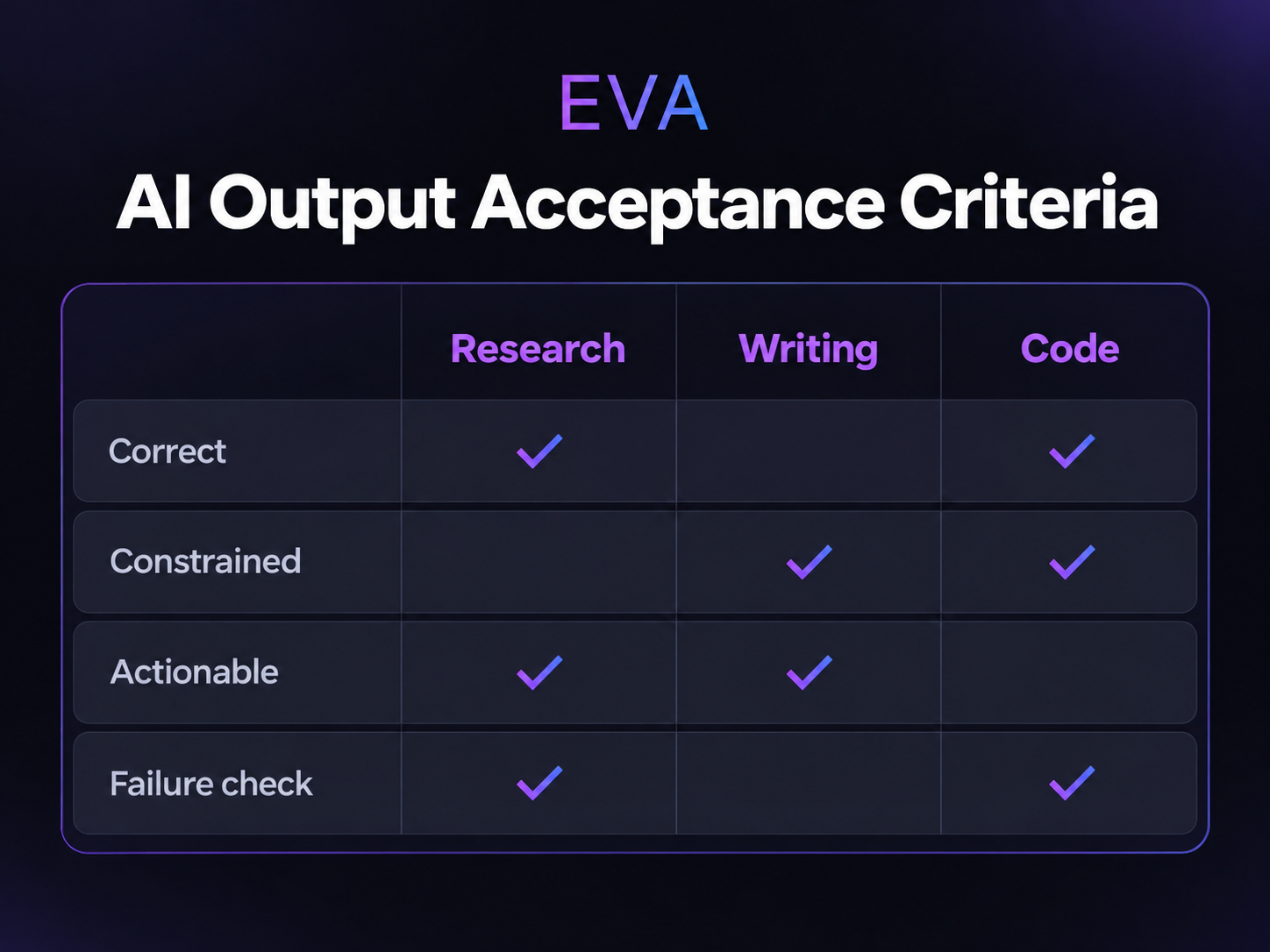
Before generating, write the few conditions that would make you accept or reject the work. A reviewer should be able to open the cited source, check the requested format, and run the relevant test. If the output survives those checks, use it. If not, repair that failure or reject the output.
"Looks good" fails the moment someone has to use it
A market summary lands in your inbox at 4 p.m. It is clean, confident, and ready to paste into the planning deck. Then you open the first citation: the page never supports the number beside it. The summary has created a fact-checking job at the worst possible time.
A short acceptance test would have caught that before review: every material number must point to a source that actually supports it, and fast-changing facts need an access date. When the answer arrives, the reviewer knows exactly what to open and what counts as failure.
Give candidate outputs the same review. Keep the one whose citations hold up and whose constraints are intact. A famous model label cannot rescue a broken source or code that changes public behavior.
The four-part core for every AI-assisted task
Teams use different labels, but reviewers keep coming back to four practical questions.
Can you prove it is correct?
The output's claims, calculations, references, and behavior must match reality. Define which facts require sources and which behavior must be tested.
Did it follow the brief?
The answer must respect the brief: scope, audience, format, source boundaries, and anything explicitly off-limits. Missing a hard constraint is a failed delivery.
Can someone use it now?
Someone should be able to take the next step without guessing. Research should support a decision, copy should fit its channel, and code should explain how to test or roll back the change.
Did you check the likely failure?
Every task has a failure mode that generic checks miss: weak evidence, an overstated claim, or a compatibility break hidden by a happy-path test. Name it before generation.
AI output acceptance criteria template
Use this blank worksheet before opening a model:
| Field | Your task |
|---|---|
| Deliverable | What must exist at the end? |
| User or decision | Who will use it, and for what? |
| Required inputs | Which files, sources, examples, or data must be used? |
| Correctness checks | Which claims, calculations, or behaviors must be verified? |
| Hard constraints | What must the output include, exclude, or preserve? |
| Actionability test | What should the next person be able to do? |
| Task-specific failure | What plausible-looking mistake would make this unusable? |
| Evidence | What source, test, or review proves it passes? |
| Stop condition | What must be true to accept the output? |
AI output acceptance criteria for research
Research can sound informed while relying on stale pages or sources that never support the sentence beside them.
| Criterion | Pass condition | Failure check | Evidence |
|---|---|---|---|
| Scope | Answers the exact question for the named market, date, and audience | Look for a broader or different question being answered | Compare with the brief |
| Source quality | Material claims use primary or credible sources | Open each cited page and locate support | Source links + access dates |
| Claim traceability | Important statements map to a source or are labeled as analysis | Find uncited numbers, rankings, or feature claims | Claim-to-source notes |
| Recency | Fast-changing facts have a current date | Check prices, product features, and model names | Official pages checked on a recorded date |
| Contradictions | Conflicting evidence is shown, not flattened | Search for sources that disagree | Conflict note + resolution |
| Decision value | Findings change or support a next action | Ask what the reader can decide now | Recommendation tied to evidence |
Worked research example
Task: Compare three AI workspaces for a small team choosing a side-by-side model-testing tool.
Weak criterion: "Produce a comprehensive comparison."
Useful criteria:
- Use each product's official pricing and feature pages, checked on the same date.
- Separate monthly price, annual equivalent, usage limits, and add-on costs.
- Verify whether "compare" means simultaneous side-by-side output or simple access to multiple models.
- Include one honest reason each product may be the better fit.
- Mark inaccessible checkout details as needing verification instead of estimating.
- End with a recommendation for the stated team, not a universal ranking.
How to set AI output acceptance criteria for writing
Writing needs more than grammar. It has a job, a reader, and a claim boundary. Good criteria preserve those while leaving room for voice.
| Criterion | Pass condition | Failure check | Evidence |
|---|---|---|---|
| Audience | Uses the reader's vocabulary and assumed knowledge | Read the opening as the intended buyer | Audience brief |
| Core message | One sentence captures the intended takeaway | Ask two reviewers what the piece says | Message recall |
| Claim integrity | Every factual claim is sourced or clearly qualified | Highlight numbers, comparisons, and promises | Source or product proof |
| Channel fit | Length, structure, links, and CTA match the destination | Compare with platform rules | Format check |
| Voice | Sounds specific, direct, and consistent with the brand | Flag generic filler and corporate phrasing | Voice checklist |
| Action | Reader knows what to do next | Remove the CTA and see whether the next step remains obvious | CTA + landing-page match |
Worked writing example
Task: Draft a landing-page section for EVA Multi Chat.
A practical acceptance set might read:
- Open with the user's problem: comparing answers across separate tabs.
- State that Multi Chat sends the same prompt to up to four models side by side.
- Do not promise a "best" model without a named test and date.
- Use the exact product name "Multi Chat."
- Include one concrete workflow example in fewer than 120 words.
- End with one action that matches the destination page.
- Reject copy that invents customer metrics, testimonials, or unreleased features.
AI output acceptance criteria for code
Code acceptance criteria should describe behavior, boundaries, and proof. "The code looks clean" is not a release gate.
| Criterion | Pass condition | Failure check | Evidence |
|---|---|---|---|
| Intended behavior | The named user path works | Run the smallest representative test | Passing test output |
| Regression safety | Existing behavior remains intact | Run relevant existing tests | Test suite result |
| Interface contract | Public inputs, outputs, errors, and types are preserved or intentionally changed | Compare API/schema before and after | Contract diff |
| Edge cases | Named empty, invalid, timeout, and permission cases behave correctly | Run explicit negative tests | Test cases |
| Security and privacy | No new secret exposure, unsafe input path, or excessive data access | Review changed trust boundaries | Security review note |
| Operability | Logs, errors, migration, and rollback are usable | Simulate failure or rollback where material | Runbook or rollback result |
Worked code example
Task: Change an orders endpoint from status to state.
Acceptance criteria should answer more than whether the new field appears:
- Existing clients receive an intentional migration path or a documented breaking response.
- The removed
pendingvalue has an explicit mapping or rejection rule. - Missing state does not silently convert an unknown order into
processingunless that behavior is approved. - Serialization, validation, and database migration tests pass.
- One compatibility test covers the oldest supported client contract.
- A rollback condition names the metric or error that triggers reversal.
Use pass/fail before you use a score
A weighted score can make a broken answer look competitive. Start with non-negotiables: fabricated sources, violated claim boundaries, and broken interface contracts are automatic failures. Compare clarity, speed, maintainability, depth, or tone only after every candidate clears those gates. This separates "acceptable" from "preferred."
Set criteria before choosing a model
Choosing the model first makes it easy to excuse its misses. Write the deliverable, intended user, hard constraints, most expensive plausible failure, and required evidence before generating. Run the same task through the candidates, then compare preferences only among outputs that pass.
Use Multi Chat when you want the same task answered side by side. Use Split Chat when drafting and critique are separate jobs. The criteria stay fixed either way.
When passing criteria is the stop condition
Passing proves that one output is acceptable for one defined task under the current conditions. It does not establish universal model quality. Record the task, model label, date, criteria, and result when the decision must be repeatable. Then stop; extra comparison adds review time and contradictory suggestions after the work is already usable.
Who This Is For / Not For
This is for: people who use AI for recurring research, content, code, analysis, or operational work; teams comparing model outputs; and reviewers who need a defensible reason to accept or reject a draft.
This is not for: open-ended brainstorming where variation is the deliverable, casual low-stakes questions, or teams looking for one permanent model ranking. Criteria evaluate outputs for a task. They do not crown a universal winner.
FAQ
What are AI output acceptance criteria?
They are observable conditions an AI-assisted deliverable must meet before use. Good criteria cover correctness, hard constraints, actionability, and a task-specific failure check. They turn a vague quality judgment into a repeatable decision.
Should acceptance criteria be included in the prompt?
Usually, yes. Include the criteria that guide generation, such as required sources, format, constraints, and tests. Keep independent review checks too, especially when asking the model to verify its own work would create a conflict.
How many criteria should I use?
Use the fewest criteria that catch costly failures. Five to eight checks are often enough for a recurring task. Add a criterion only when it changes acceptance, rejection, or the next action.
Can one checklist work for research, writing, and code?
The four-part core can: correct, constrained, actionable, and failure-checked. The proof must change by task. Research needs source checks, writing needs message and claim checks, and code needs behavioral tests and contract review.
Does a passing output mean the model is reliable?
It means that output passed that task's criteria at that time. Model behavior, versions, prompts, and context can change. Keep the conclusion task-specific and date-anchor repeatable evaluations.
When should I compare multiple AI models?
Compare when the task matters enough that alternative reasoning or execution could expose a failure, or when no single output clears the criteria. Stop once an output passes every required gate and the remaining differences are preferences.
Make "done" visible before the first prompt
The strongest acceptance criteria are written before the answer appears. They define reality, protect hard constraints, expose the expensive failure, and tell the reviewer exactly what proof to request.
Build one short checklist for each recurring task. Use pass/fail gates before preference scores. Compare models only until an output clears the bar. "Good enough" should not be a feeling, and "keep comparing" should not be the default.
Copy the checklist, adapt it to one recurring task, and test candidate outputs in EVA with Multi Chat or Split Chat at evaonline.ai.