AI How-To Guides
How to Write a Portable AI Task Brief That Survives a Model Switch
October 4, 2026 · 8 min
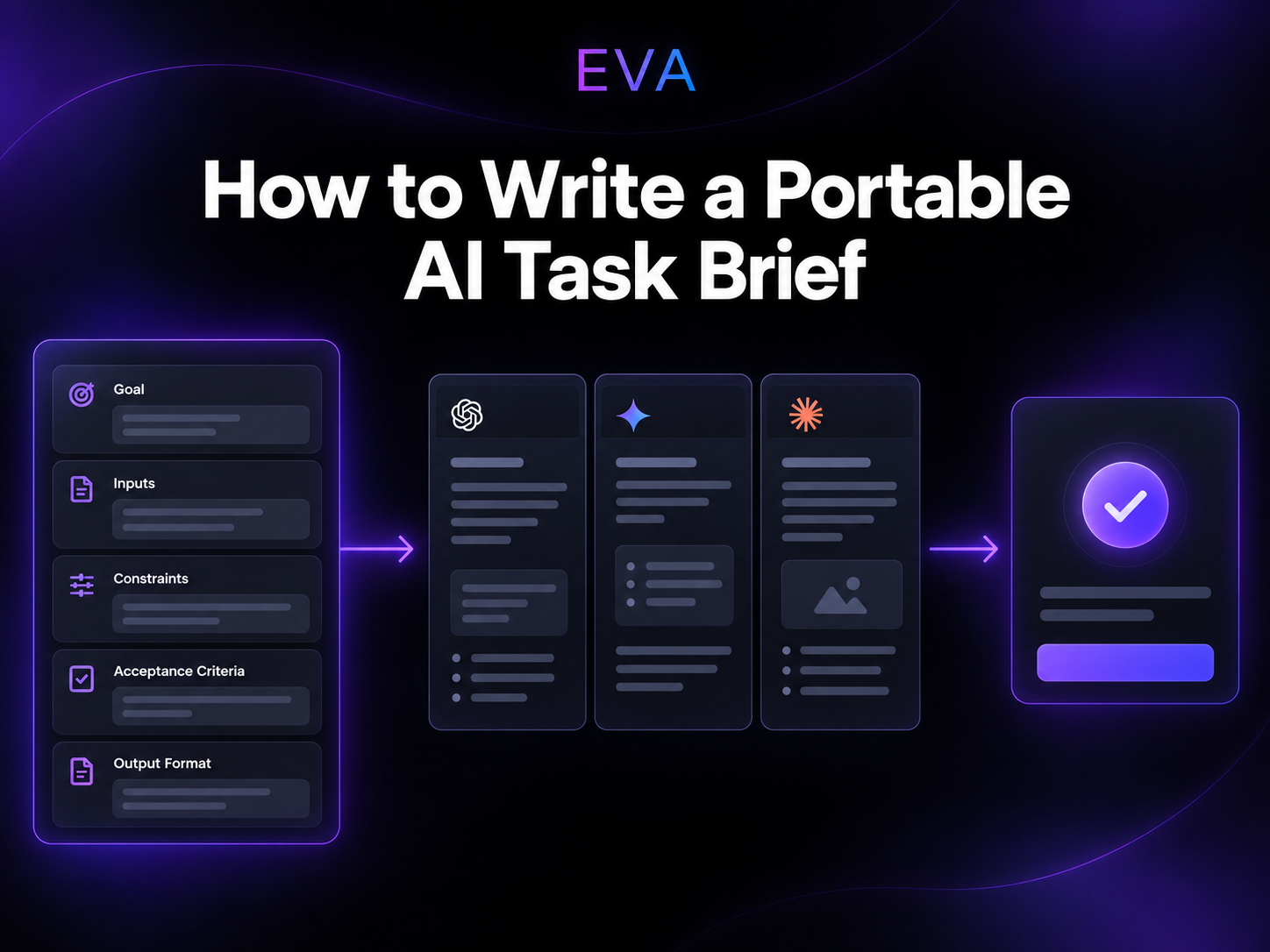
Write a portable brief in five parts: goal, inputs, constraints, acceptance criteria, and output format. Keep facts separate from instructions, make every critical requirement testable, and send the same self-contained brief to each model. Compare the outputs against the criteria, not against whichever answer sounds most confident.
The five minutes that save the second hour
This format earns its keep the moment you switch models. You might start a product announcement in one model, move to another for a tighter rewrite, then ask a third to check the claims. Without a written brief, each move turns into an archaeological dig through old messages.
A product manager asks for a CSV export release note. The model writes a clean paragraph but quietly adds Excel support, drops the 10,000-row limit, and invents a customer quote. Now the reviewer has to reconstruct the original request just to find the errors.
This is where a five-minute request becomes an hour of checking old messages. A small contract for the work prevents that. Five fields cover most writing, research, planning, and review jobs.
The five fields that travel with the work
1. Goal: name the finished job
Describe the result, not the activity. "Write about CSV export" leaves too much room. "Produce a 120-word release note for the CSV export launch" gives the model a finish line.
A useful goal answers two questions:
- What must exist when the task is done?
- Who will use it, read it, or approve it?
If the task has stages, name the current one. "Create an internal outline" and "write publish-ready copy" are different assignments.
2. Inputs: separate facts from context
Inputs are the materials the model may rely on: product facts, excerpts, data, source URLs, customer language, or an existing draft. Label verified facts clearly. If a fact is unresolved, move it to an open-question field or state that it must not be assumed.
This separation matters because fluent models can smooth over a missing fact so well that the invention is hard to spot. A short fact list is easier to audit than facts buried across six paragraphs of instructions.
3. Constraints: define the walls
Constraints say what the output must not do. They can cover scope, claims, tone, length, sources, legal boundaries, or formatting rules.
Good constraints are specific: "Do not claim Excel export" is stronger than "Be accurate." "Include the 10,000-row limit" is stronger than "Mention limitations." If a failure would block publication or shipping, write it down.
4. Acceptance criteria: make review mechanical
Acceptance criteria turn taste into a check. A reviewer should be able to mark each item pass or fail without interpreting your intention.
For the release note, the criteria might be:
- Exactly one product capability is announced: CSV export.
- Pro availability is stated.
- The 10,000-row limit appears.
- The launch date is 15 October 2026.
- No customer quote or Excel claim appears.
These checks also make side-by-side comparison fair. You can prefer one model's voice, but factual compliance comes first.
5. Output format: remove layout guesswork
Tell the model what to return and in what order. This can be a Markdown table, JSON object, memo, code patch, or a paragraph followed by a checklist.
A precise output format helps downstream work. If four models all return the same sections, you can compare them quickly instead of untangling four different presentations.
Copy this portable AI task brief template
Use this block as a starting point. Delete fields that genuinely do not matter; don't fill them with ceremonial prose.
ROLE OR PERSPECTIVE (optional)
You are [relevant role or reviewer perspective].

GOAL
Produce [specific deliverable] for [audience/use].

INPUTS
Verified facts:
- [fact]
- [fact]

Source material:
- [text, file, or URL]

Unresolved information:
- [question that must not be guessed]

CONSTRAINTS
- Must [requirement].
- Must not [prohibited claim or action].
- Keep within [length, scope, or technical boundary].

ACCEPTANCE CRITERIA
Mark the result PASS only if:
- [testable condition]
- [testable condition]

OUTPUT FORMAT
Return:
1. [deliverable]
2. [checklist, citations, assumptions, or next action]
The role line is optional. The other five parts should survive outside the original conversation. If someone can paste the brief into a clean session and understand the job, it is portable.
A filled portable AI task brief for a product release
Here is the exact demo brief to run in EVA Multi Chat:
You are reviewing a product launch brief.

Goal: produce a 120-word release note for a new CSV export feature.

Facts: export supports CSV only; available to Pro accounts; maximum 10,000 rows; launch date is 15 October 2026.

Constraints: do not claim Excel export, do not invent customer quotes, include the row limit, and end with one clear action.

Acceptance criteria: the release note is 120 words; says CSV only; names Pro availability; includes the 10,000-row limit and 15 October 2026 launch date; contains no invented quote or Excel claim; ends with one clear action.

Output: release note followed by a four-item constraint checklist marked PASS or FAIL.
How to test a portable AI task brief across models
A good comparison uses one unchanged brief. Open EVA Multi Chat at evaonline.ai, select up to four currently available models, and send the exact text once. EVA's Multi Chat workflow places the responses side by side; confirm the live model labels and interface during capture because availability changes.
Then review in this order:
- Hard failures. Reject any answer that invents Excel support, misses the row limit, or changes the date.
- Acceptance criteria. Mark each requirement pass or fail. Do not award partial credit because the prose sounds polished.
- Usefulness. Compare clarity, editing effort, tone, and whether the requested action is actually clear.
- Human decision. Choose the strongest compliant answer, combine useful parts if needed, and verify the final copy yourself.
Keep the brief fixed during the first round. If you change it for one model, you are comparing prompts as well as models. A second round can refine the winning output with targeted feedback.
Portable brief versus conversation-dependent prompting
| Review point | Conversation-dependent prompt | Portable brief |
|---|---|---|
| Source facts | Scattered across earlier messages | Listed in one visible input section |
| Boundaries | Often implied | Written as explicit constraints |
| Definition of done | Based on the reviewer's memory | Expressed as pass/fail criteria |
| Model switching | Requires reconstruction | Can move into a clean session |
| Side-by-side testing | Outputs answer different interpretations | Models receive the same assignment |
| Audit trail | Hard to explain later | Brief shows what the model was told |
Conversation history still has value. It holds exploration, earlier drafts, and working decisions. But hidden history is a weak handoff format. The portable brief is the compact version of the task that a new model or teammate can inspect.
Common mistakes that break portability
Mixing facts with instructions
"Write a confident announcement about our flexible export options" mixes tone with a claim that may not be true. Put verified capabilities under inputs. Put voice under constraints or output guidance.
Using soft acceptance criteria
"Make it engaging" cannot be tested consistently. Pair subjective direction with concrete checks: include the action, stay within the word limit, and avoid claims outside the fact list.
Asking the model to remember the conversation
"Use everything we discussed above" works only inside that thread. A portable brief should make sense when pasted into a new session with no prior messages.
Treating the first answer as final
The brief improves transfer, not truth. Models can still miss a constraint or introduce an unsupported detail. The acceptance checklist and human review remain mandatory.
Who This Is For / Not For
This is for: product managers moving work between tools, developers asking different models to plan and review a change, researchers comparing synthesis, marketers checking claims, and anyone who needs a reproducible assignment across model families.
This is not for: casual one-line questions where no context must survive, open-ended brainstorming that benefits from deliberate ambiguity, or teams looking to remove human approval from factual or high-stakes work.
FAQ
How long should a portable AI task brief be?
Use the shortest brief that contains the full assignment. A routine writing task may fit in 150 words. A technical review may need source excerpts, interfaces, and several acceptance checks. Portability comes from completeness and clarity, not length.
Should I include the model's role?
Only when the perspective changes the review. "Act as a security reviewer" can focus an audit. A decorative role such as "world-class expert" usually adds noise without making the task more testable.
Can the same brief work with GPT, Claude, Gemini, and other models?
Yes, if it is self-contained and uses clear language rather than provider-specific features. Output quality may differ, which is exactly why the same brief is useful for comparison. Verify current model labels and availability on the day you test.
What if one model needs different instructions?
Run the unchanged brief first to establish a fair baseline. Then create a documented second version for provider-specific features or formatting. Do not mix those rounds when you compare results.
Does a portable brief replace conversation history?
No. History preserves exploration and prior work. The brief extracts the task state that must travel: what to produce, what is known, what is forbidden, how success is judged, and what shape the answer should take.
Use the brief as the control surface
A favorite model can be useful. A task that only works inside that model's old thread is fragile.
Write the five fields before you switch: goal, inputs, constraints, acceptance criteria, and output format. Run the same brief across models, reject hard failures first, and make the final call yourself. That gives you a workflow you can inspect, repeat, and improve.
Copy the template, test it in EVA Multi Chat at evaonline.ai, and compare the results before you publish.