AI Use Cases
AI incident status update: write only what the log supports
November 21, 2026 · 6 min

To write an AI incident status update, give the model a sanitized, timestamped log and require a source label for every factual sentence. Forbid unsupported causes and recovery promises; require evidence for any impact estimate. Supply the next update time yourself, then check the draft against the log before anyone posts it.
What should an AI incident status update include?
Start with the observed problem and the response work confirmed in the log. End with the next scheduled update.
“Checkout errors increased” tells customers what was observed. “A database issue affected a small number of customers” adds a cause and an impact estimate. If neither appears in the log, delete both, even if the sentence sounds reassuring.
An incident update should describe confirmed observations and actions. A plausible explanation belongs in the investigation until someone verifies it.
As of November 20, 2026, Atlassian's incident communication guide recommends choosing a primary communication destination and directing people there from other channels. For the draft, gather the facts in one place too. Don't hand over scattered messages and expect the writer to know which responder's account is current.
What should you give the model, and what must it leave out?
Give the model only material approved for that tool and account, with timestamps, source labels, and a human-set next update time. Remove secrets and customer identifiers before submission; don't ask the model to perform the only privacy check.
A rollback that has started is an awkward detail to compress. “Rolled back” reads more cleanly, but it says the action finished. Keep the awkward detail. The customer note can be short without erasing what the responders still don't know.
A useful packet includes:
- The affected function as confirmed by the incident owner, using names customers recognize.
- Timestamped observations and response actions, each with a stable label.
- Explicit unknowns, including unconfirmed outcomes.
- An approved next update time and the timezone customers should see.
Check internal system names before including them. A useful debugging detail can be meaningless to a customer, or something your team hasn't approved for public discussion.
A next update time tells customers when they'll hear from the team again. It doesn't tell them when checkout will work.
Atlassian's communication templates, checked November 20, 2026, include next-update placeholders for outage messages and distinguish internal from public notices. A template still needs a responder to fill those blanks.
A prompt you can copy
This is an adapted template, not the exact prompt used in the recorded run below. The word limit is an editorial constraint from that demo; adjust it when the facts need more room.
Incident log (UTC), one fact per line:
L1 <time> <fact>
L2 <time> <fact>
...
Next update due: <time>

Write a customer-ready status note, maximum 55 words.
Cite each factual sentence with its log ID, like [L2].
Do not add a cause, impact scope, or recovery time unless a log line states it.
Keep uncertain items uncertain ("outcome unconfirmed").
End with when the next update is due. Return only the note.
Before using the template, replace the placeholders. Put the approved next update time in a labeled log entry too, so the last sentence has a source. If nobody has committed to a time, get that decision from the communication owner rather than allowing the draft to invent one.
The recorded draft, with the source beside it
On November 19, 2026, we ran a recorded drafting demo in EVA that gave GPT-6.1 Sol this fictional UTC log:
L1 14:02 checkout errors rose.
L2 14:07 team investigating; cause unknown.
L3 14:12 rollback started, outcome unconfirmed.
L4 14:15 next update due 14:30.
The prompt asked for a customer-ready note with a maximum of 55 words, a log ID for each factual sentence, and no invented impact scope, recovery time, or cause. The response was:
Checkout errors increased at 14:02 UTC. [L1] At 14:07 UTC, the team was investigating; the cause was unknown. [L2] A rollback began at 14:12 UTC, but its outcome remains unconfirmed. [L3] The next update is due at 14:30 UTC. [L4]
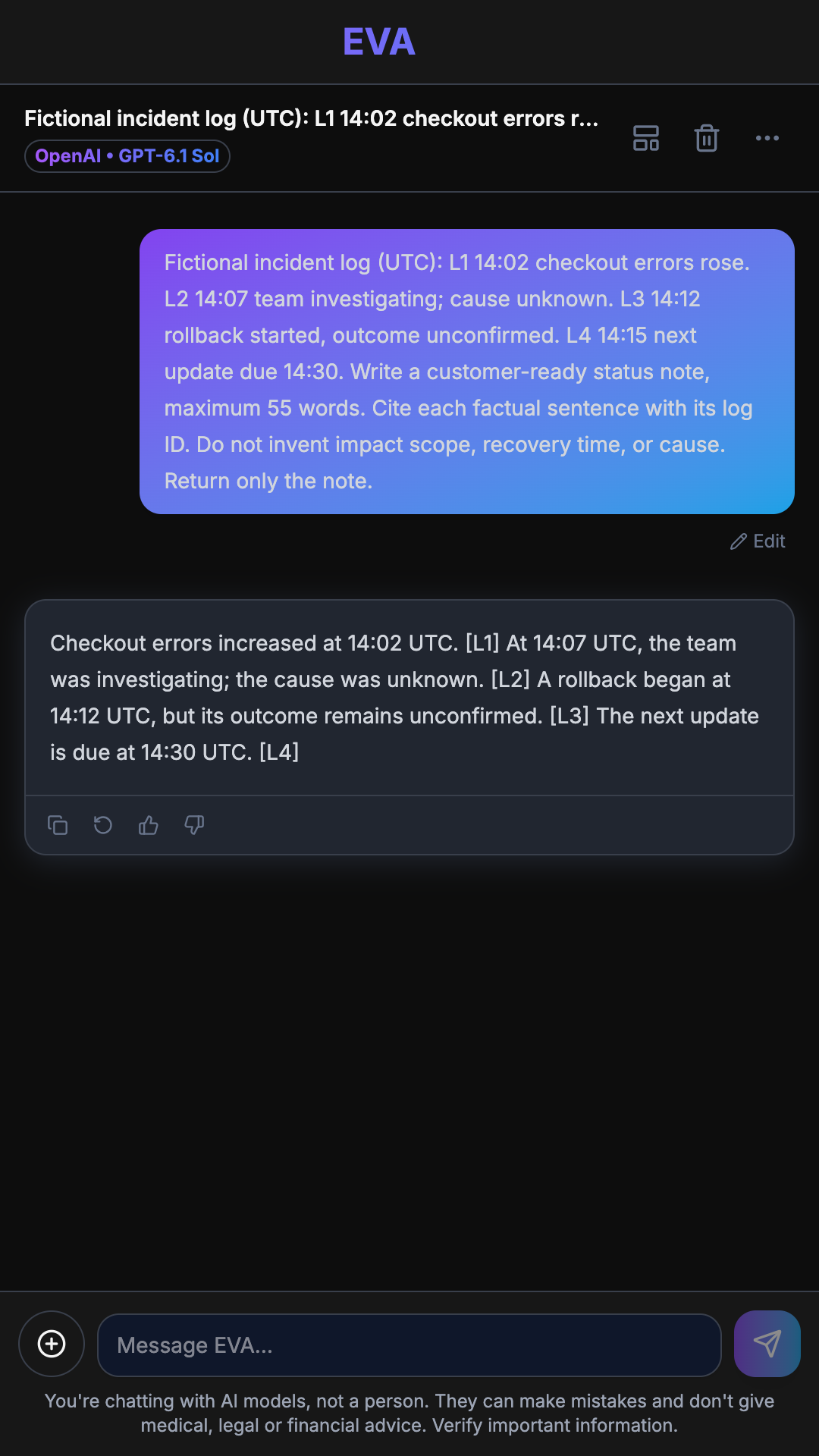
Look at “its outcome remains unconfirmed.” That qualification comes straight from L3, and it survived into the customer note. The cause stays unknown too. Check those words before you worry about tone.
This fictional example demonstrates the method, not general model accuracy. The note wasn't sent to customers.
How do you check the note before posting?
Read every factual sentence against its cited line, including qualifications such as “unknown” and “unconfirmed.” A correct-looking label doesn't prove the sentence matches its source.
Start with L4. It records the scheduling decision at 14:15, but the promised update is at 14:30. Swapping those times would change the message even though both numbers came from the right source. Check the timezone while you're there.
A source label makes an incident claim traceable. The reviewer still has to check that the cited line supports the whole sentence.
You can ask another model to review the same packet. Supply both the original log and the exact draft, not just the draft and a request to “make it better.” A reusable audit prompt is:
Audit this note against the log. Check: unsupported cause, impact scope,
recovery promises, citation accuracy. Return: Verdict, Issues (none if none),
then the final note. Do not invent a defect.
That last line matters. A reviewer told to find problems will often find one, real or not.
In the November 19 review demo, we manually gave Claude Opus 5.5 the same log and the first model's note. Its verdict was:
Verdict: Pass
Issues: None
It repeated the note unchanged. In this run there was nothing to fix, and it didn't make something up. This was a manual review step, not an automatic handoff or judge feature in EVA.
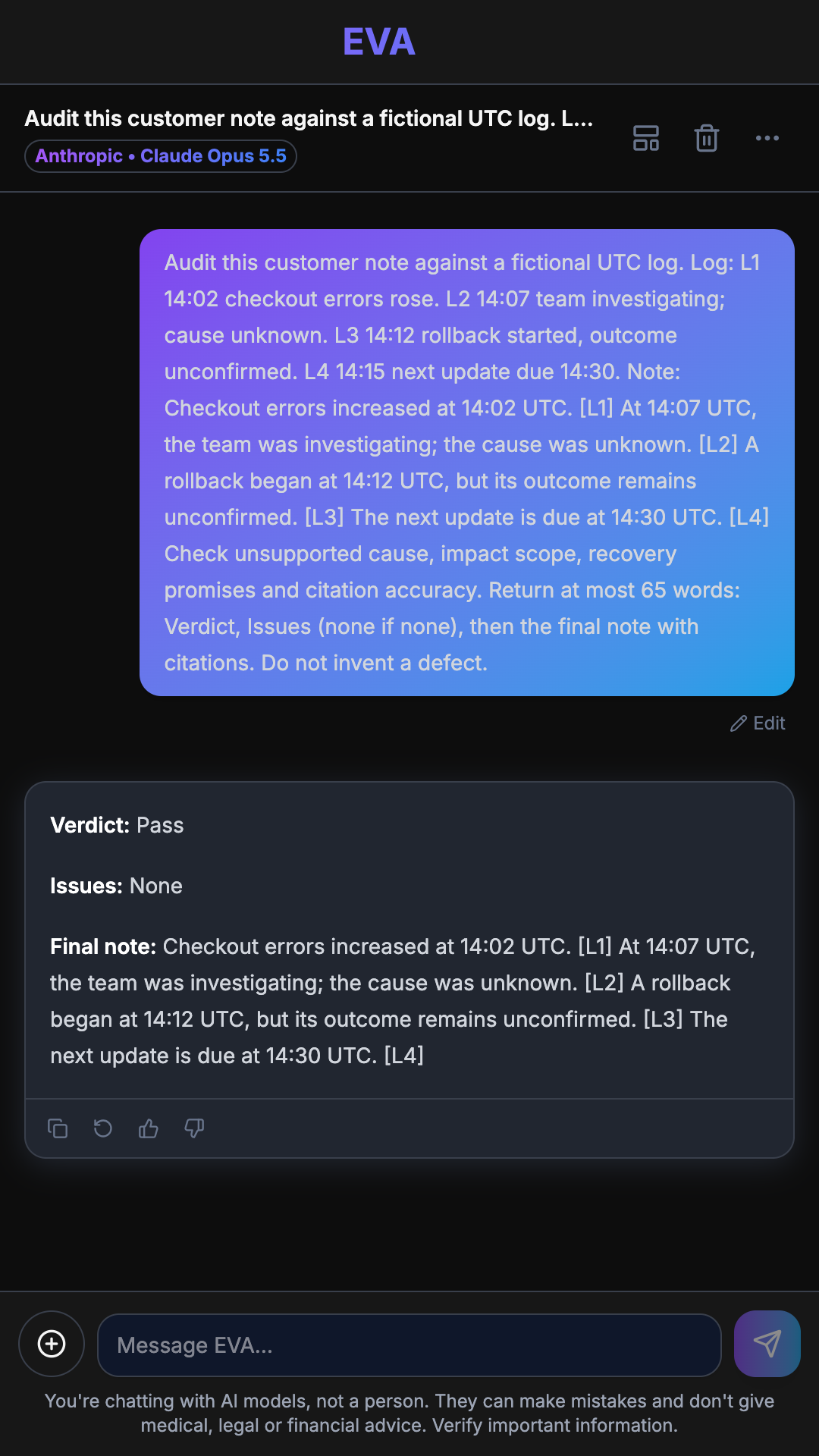
Keep a human responsible for the final wording and release. As of November 20, 2026, Google's Managing Incidents chapter assigns periodic stakeholder updates to a communications lead. Asking a model to draft text doesn't transfer that responsibility.
Customers won't have your internal L1 or L3. Remove those labels from the public version if they aren't useful to readers, but keep the labeled copy with the review. Compare the versions before release; the cleanup should change presentation, not facts.
The next update needs fresh evidence
L3 needs to keep its original meaning after the next update. If it gets overwritten with a later rollback result, someone checking the earlier message will be reading the wrong evidence. Append the new observation with a new label instead.
Once someone confirms recovery or identifies a cause, include the supporting entry in the next packet. Ask for a new draft using the current evidence rather than telling the model to continue its earlier story. Check that the next update commitment is still one the team can meet.
For a different version of the missing-data problem, see invoice extraction without made-up values. Once the incident ends, the AI postmortem review guide covers the longer account of causes and follow-up work; that account doesn't belong in a mid-incident status note.
Compare drafts from the same approved log in EVA, then have the incident owner approve the note whose claims match the evidence.